SearchSearch
Edward Sturm · Aug 2, 2026
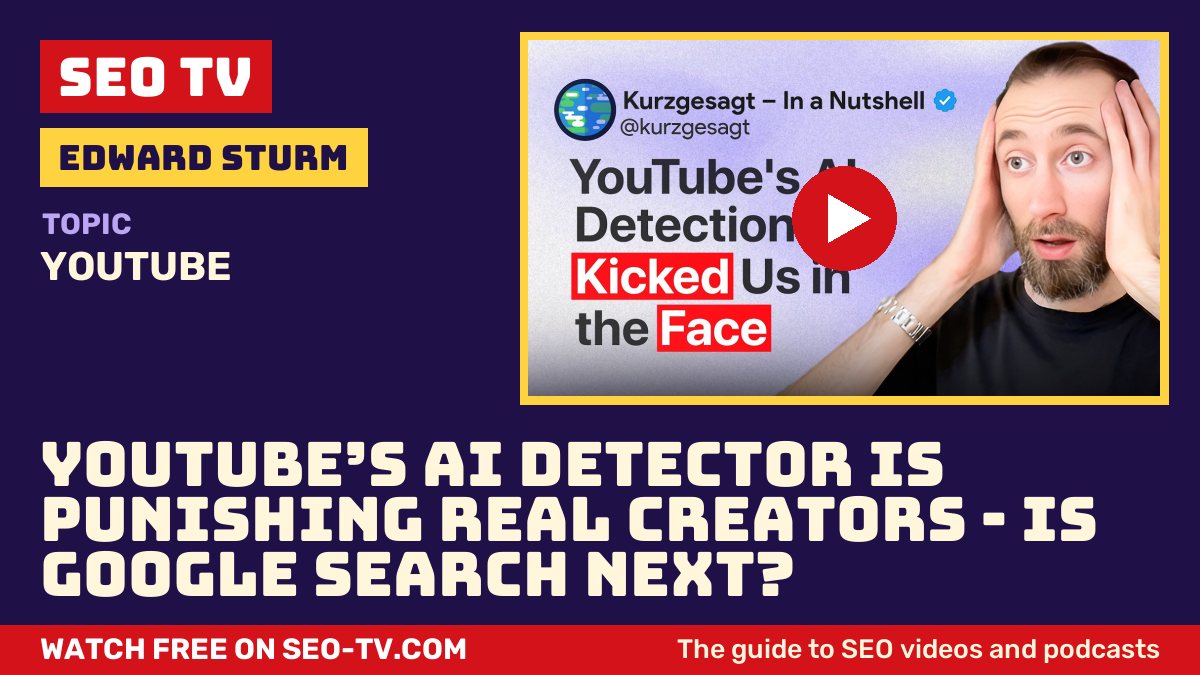
E1124: YouTube’s AI detection system classified videos from Kurzgesagt as AI-generated spam, even though the videos are made with love by ducks and people.
That mistake sharply reduced distribution for one of the largest science channels on YouTube. The affected video performed well on the usual quality signals:
- People clicked at an above-average rate
- Viewers watched for longer than usual
- Audience feedback was positive
But the video still became the channel’s worst-performing upload since 2013.
YouTube later confirmed that its automated systems had incorrectly identified the channel’s content as AI-generated material.
We look at why that matters for SEO.
Google and YouTube are both part of Alphabet, and both platforms are working to detect large-scale AI spam. Research connected to YouTube has described systems that can analyze patterns across text, media, accounts, and publishing networks.
These systems look for signals such as:
- Repeated AI-generated text patterns
- Similar text embeddings across many accounts
- Shared templates and sentence structures
- Repeated terms and phrasing
- Coordinated publishing behavior
- Groups of sites or accounts using similar content systems
- Poor engagement signals across a larger network
The concern is that these systems will not always distinguish between low-quality automated content and legitimate work.
A real creator, publisher, or business could be affected because its content happens to share patterns with a larger group of AI-generated pages.
We cover:
- What happened to Kurzgesagt
- Why YouTube reduced the reach of the channel’s video
- How automated AI detection can make mistakes
- Why this incident matters for Google Search
- How Google may identify scaled AI content
- Why common AI writing tools can create detectable patterns
- How default prompts and templates can make websites look similar
- Why an entire group of sites could be judged together
- How user behavior may influence spam classification
 SEO Experts Are Hiding Their Best Tactics From AI
 Joy Hawkins: Google Search Console Is Showing Fake Clicks (And Rank Trackers Are Wrong)
 Salesforce's CEO Says SEO Is Dead. Google Searches Are at an All-Time High.
 How to Spot Fake Backlinks (From Someone Who Used to Sell Them)
 Google’s November Core Update Is Crushing AI Content Sites
 He Bought a $200/Month Affiliate Site for $4K. It Hit $30K/Month
Newer: Why Republishing Under a New URL Can Make a Dead Page Rank #1All Edward Sturm Videos
 Edward Sturm Alerts by Email
Edward Sturm alerts by email tell you the hour something new from Edward Sturm reaches SEO TV. Confirm once and stop any time.