SearchSearch
Edward Sturm · Sep 26, 2026
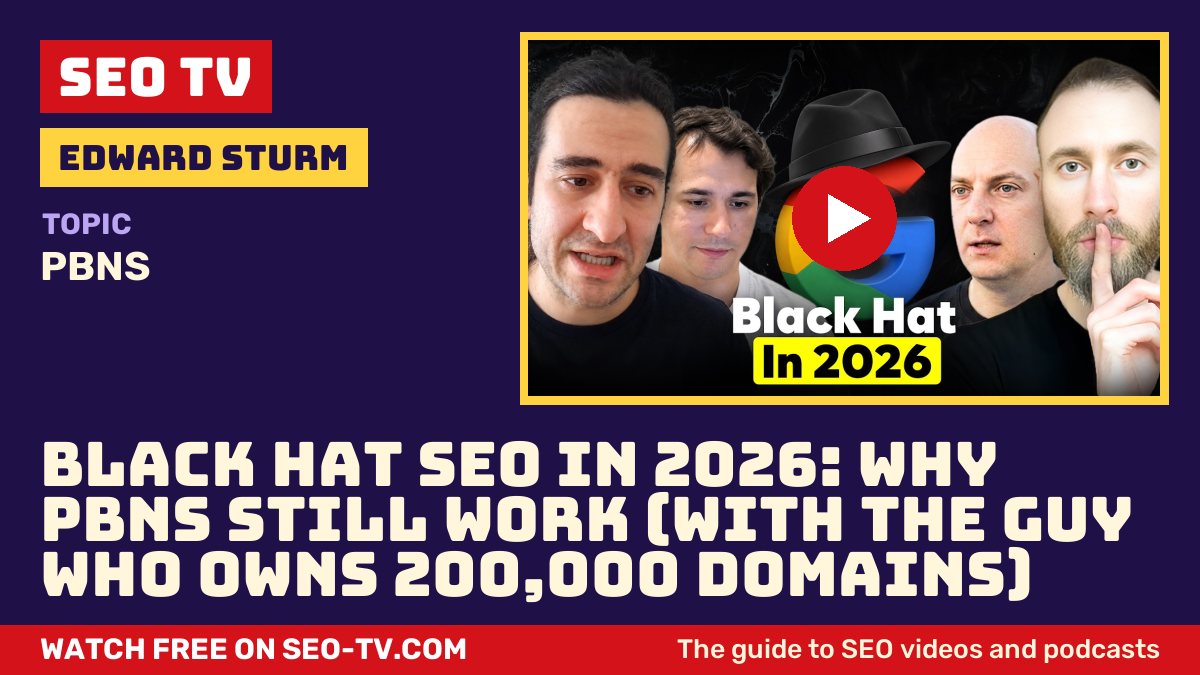
E1179: PBNs still work in 2026, and Kalin Karakehayov has the numbers to back up why he thinks they remain one of the most underrated strategies in SEO.
I’m joined by Kalin Karakehayov, Charles Floate, and David Quaid for a deep discussion on black hat SEO, private blog networks, aged domains, backlinks, AI search, parasite SEO, and where search is heading next.
Kalin owns more than 200,000 domains and operates 30,000 websites. He explains why PBNs have become easier to operate than they were a decade ago, why his network doesn’t need organic traffic to pass value, and how he evaluates domains based on strength, relevance, history, and geography.
Charles and David push the discussion further into how agencies could build private networks of their own, why backlinks remain fundamental to ranking, and why so many SEOs have moved away from link building even though links still drive results.
Then the conversation moves into AI search.
Kalin explains his research into Common Crawl and harmonic centrality, a link metric based on proximity across the web rather than the traditional PageRank model. He lays out a theory for using domains with high harmonic centrality to increase crawling and increase the chances of websites entering AI training data.
Charles explains how Common Crawl data can be reverse engineered to find valuable domains and connections between websites, and we discuss what this means for GEO, AI citations, brand associations, and the future value of aged domains.
We get into:
- Why Kalin believes PBNs are underrated in 2026
- PBNs vs. public link farms
- Why private networks are harder for Google to identify
- Why backlinks without traffic still pass value
- How Kalin evaluates aged and expired domains
- Exact-match domains and partial-match domains
- Why valuable domains keep getting more expensive
- PageRank vs. harmonic centrality
- Reverse engineering Common Crawl
- Negative SEO in AI search
 How to Spot Fake Backlinks (From Someone Who Used to Sell Them)
 Google’s November Core Update Is Crushing AI Content Sites
 He Bought a $200/Month Affiliate Site for $4K. It Hit $30K/Month
 Affiliates Are Hijacking Perplexity With Google Docs (16% of Citations)
 Google Can Detect AI Content (But Not All AI Content Is Equal)
 Google Is Testing Removing AI Mode (Because AI Ads Don’t Pay)
Newer: Google's September 2026 Spam Update Is Here (And It Came With a Secret AI Spam Detector)Older: Ross Hudgens: The Page Type That Drives the Most AI Search TrafficAll Edward Sturm Videos
 Edward Sturm Alerts by Email
Edward Sturm alerts by email tell you the hour something new from Edward Sturm reaches SEO TV. Confirm once and stop any time.